



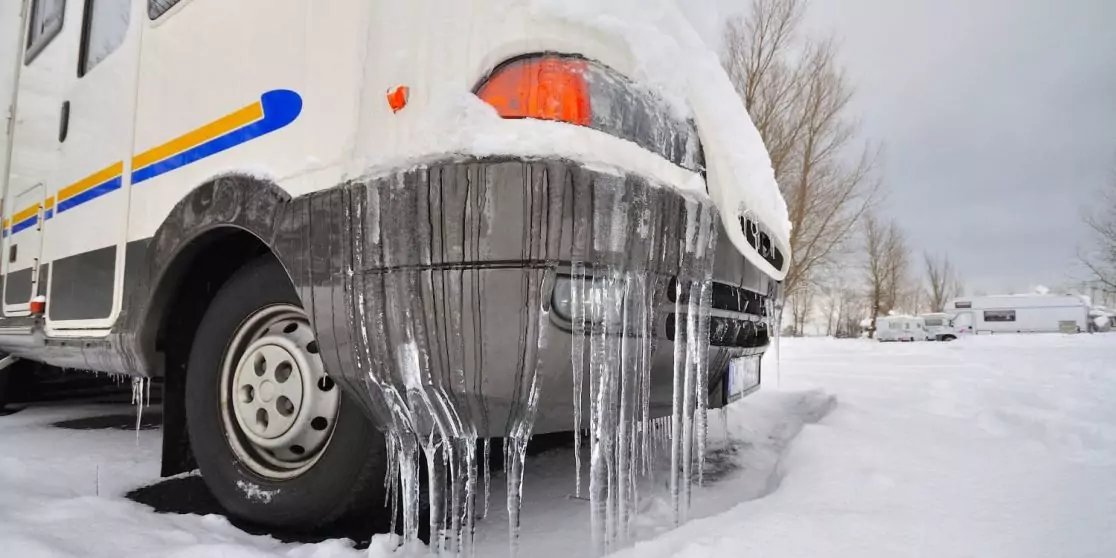



Wasseranlage im Camper vor Frost schützen
So bringst du die Wasseranlage schadlos durch den Winter
If you park your camper over the winter, you should pay special attention to the water system. Frost-related damage can be avoided: either drain the water system or fill the tank and hoses with antifreeze.
Inhoudsopgave
- Avoid frost damage to hoses, fittings and tank
- Protect water system from frost: drain completely
- The advantages and disadvantages of an empty water system
- Protect water system from frost: fill with antifreeze
- Caution with antifreeze in Truma heaters
- Overview of antifreeze for the water system
- Advantages and disadvantages of antifreeze
- Conclusion: two approaches, one goal
Avoid frost damage to hoses, fittings and tank
As long as a camping vehicle is occupied in winter and therefore also heated, you can use the water system without hesitation. However, if the camper is wintered outdoors and with a filled water system, hoses and fittings can be damaged. Physics is to blame, because as the water in the pipes turns to ice, it expands. In the process, it exerts pressure on hoses and fittings, which can burst in the worst case.
Particularly at risk from frost damage are the connections to the water taps and tank. This is because they are made of thermosetting plastic – a material that does not stretch and breaks when subjected to too much stress. The water hoses, on the other hand, are made of thermoplastic. This expands to a certain degree.
So how do you protect the water system from frost? Frost damage can be prevented in two different ways. On the one hand by draining the entire water system and on the other hand by filling the water system with a suitable antifreeze.
Here you can read how to protect your waste-water tank from frost at sub-zero temperatures.
Protect water system from frost: drain completely
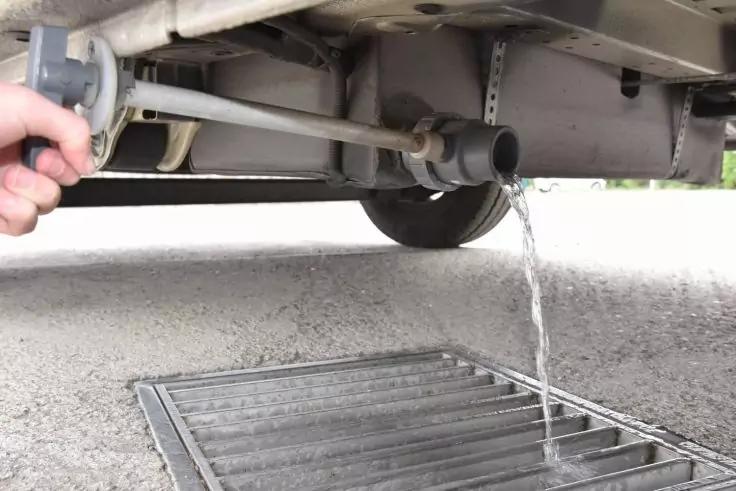
As long as the water system is dry, hoses and fittings cannot be damaged by frost. When draining the water system, you can proceed as follows:
- Make sure that the water pump is switched on. For this, the 12-volt main switch on the control panel must be activated. Often there is also an additional main switch that activates the water pump.
- Open the drain valve on the water tank. Some tanks have an outlet at the bottom, so a large part of the water runs off directly without having to pump it into the waste-water tank first.
- Set all taps to the middle position so that the hot and cold water pipes run empty equally.
- As soon as no more water flows out of the taps, switch off the pump (important: the water pump must not run dry for a long time). Leave the taps open during the winter break so that air exchange can take place.
- Now you can blow out any remaining water from the fittings and hoses with a balloon. To do this, blow up a balloon and pull it with the opening over a water tap. Now let the air escape from the balloon. The air pressure forces the remaining water out of the fitting and hoses through the open water tank.
- The blow-out does not usually work on the shower head in the shower. On the other hand, the shower can be quickly detached from the hose by turning it and stored elsewhere if necessary.
- To reduce the risk of mould formation, the inspection opening (cleaning opening) on the water tank should remain open during the winter. This means that there is a constant exchange of air in the tank.
- You can remove an immersion pump from the water tank and store it in a warm place during the winter break. If, on the other hand, your camping vehicle is equipped with a pressure pump, you must also remove all water from it. You will find instructions on how to do this in the operating instructions.
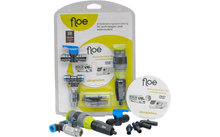



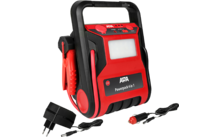



Here I show you how to completely drain your water system with Floe.
The advantages and disadvantages of an empty water system
Little material expenditure necessary
Uncomplicated and quick implementation
Siphons and hose coils cannot always be dried completely
Protect water system from frost: fill with antifreeze
Instead of emptying the water system, you can also fill it with antifreeze over the winter. Special antifreeze suitable for use in drinking water systems and waste-holding tanks is available from specialist camping shops.
Never pour windscreen antifreeze, methylated spirits or similar liquids into the water system. Residues can affect your health and the condition of hoses, fittings and other components.
An antifreeze is not suitable for drinking, even if the properties “non-toxic” or “tasteless” are noted on the packaging! The additive is only intended to protect the water system from frost damage during the unused period. Therefore, you must first thoroughly rinse the water tank and hoses with fresh water at the beginning of the season. This is not necessarily an additional expense, as you should clean the water system in spring anyway.
You can find out here what you need to bear in mind when cleaning the drinking water system.
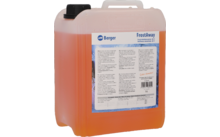
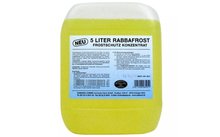

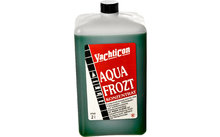

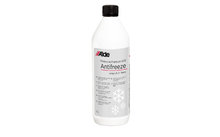

Determining the correct mixing ratio for antifreeze
Antifreeze is available in containers of up to 5 litres. This is always a concentrate that is mixed with water in a certain ratio.
Example mixing ratio Berger FrostAway
| Parts antifreeze: | Parts water: | Antifreeze down to: |
| 5 | 5 | -10 °C |
| 5 | 2,5 | -20 °C |
| 5 | 0 | -40 °C |
To achieve frost protection down to -20 °C, for a water tank with a volume of 60 litres you need 40 litres of Berger FrostAway antifreeze and 20 litres of water according to the 1:2 mixing ratio.
After the water tank is completely filled, the antifreeze must also be able to distribute itself over all hoses and fittings. To do this, open all the taps to the middle position until the water flows out evenly.
Antifreeze retains its effect for a long time. In spring you can collect the antifreeze/water mixture and use it again for the next winter season.
You cannot only fill the water tank with antifreeze. Flush water tanks and waste-holding tanks can also be protected from frost damage with the additive.
Caution with antifreeze in Truma heaters
Truma advises against the use of antifreeze in Truma Combi heaters. According to the manufacturer of heating and water systems, the antifreeze can cause the water containers to rust. Truma also points out that the magnetic antifreeze valve (Frostcontrol) must not be manipulated. This valve is used to protect the water system and automatically opens a drain on the boiler from an outside temperature of 3 degrees. As long as the motorhome or caravan is heated, the valve will keep tight. With winterised camping vehicles, on the other hand, the water system would empty itself automatically. Instead, Truma recommends completely draining the water system as described above.
Overview of antifreeze for the water system
Here you can find all antifreeze products in the Berger online shop. I would like to introduce a selection here.
Berger FrostAway
Mixing ratio down to -10 °C: 1 litre FrostAway to 1 litre water.
Special feature: frost protection down to -40 °C, environmentally friendly and non-toxic
Container: 5 litres
Rabbafrost
Mixing ratio down to -12 °C: 1 litre Rabbafrost to 2 litres fresh water
Special feature: not suitable for stainless steel, zinc and brass
Container: 5 litres
Yachticon Aqua Frozt
Mixing ratio down to -21 °C: 1 litre Aqua Frozt to 1,5 litres fresh water
Container: 2 litres
Advantages and disadvantages of antifreeze
High protection against frost damage
Can be reused multiple times
Antifreeze costs money
Conclusion: two approaches, one goal
Drain or fill with antifreeze? Both methods involve some work. But it is worth the effort to ensure that the tank, hoses and fittings survive the winter break without damage. And in both cases: clean the water system thoroughly before the first camping trip in the new year. Due to the purchase costs, an antifreeze is mainly suitable for water systems with smaller tanks or canisters. If you want to drain the water system, you should work particularly thoroughly so that no residual water remains in the siphons and hose coils.
Here you can find all products for frost protection in your camper in the Berger online shop.
